GEO Strategies to Improve Visibility in AI-Generated Search

Imagine your carefully crafted content being overlooked while an AI tool cites your competitor instead. That’s the new reality: AI-powered search isn't coming—it's already shaping how people find answers. Today, nearly half of younger audiences start their queries on ChatGPT, Bing Copilot, or Perplexity rather than traditional search engines. If your strategy hasn’t adapted, you’re leaving visibility—and opportunities—on the table.
Generative Engine Optimization (GEO) is no longer an experiment or buzzword. It’s a practical approach that ensures your content is selected, summarized, and cited by AI-driven platforms. Brands that understand how AI evaluates clarity, authority, and structured content are gaining a real competitive edge, seeing higher engagement, and becoming the sources AI trusts to answer questions accurately.
But here’s the truth: GEO isn’t just traditional SEO with AI added on. It’s about designing content specifically for the way AI consumes, interprets, and presents information — turning your expertise into answers that reach the right audience at the right time.
Who This Guide is For?
This guide is for teams navigating the shift to AI-driven search and content discovery.
It is designed for three key audiences:
-
SaaS and enterprise software companies .
-
Marketing leaders who need to adapt their strategies for AI search
-
Content teams that prepare content for AI platforms.
How AI-Generated Search Works
AI search engines don’t “rank” content the same way traditional search does. Instead, they scan indexed content, identify trusted entities, extract concise answers, and summarize information from multiple authoritative sources.
AI-generated search systems typically:
-
Analyze entity-based topics: AI identifies the "Who" and "What" of your content to determine if you are a credible source for the specific subject.
-
Map brand relationships: The system connects your brand and authors to industry concepts, building a "Knowledge Graph" of your expertise.
-
Prioritize RAG-ready data: AI favors modular, well-structured text that can be easily "retrieved" and used as a factual foundation for its answers.
-
Summarize authoritative sources: The engine synthesizes verified data from multiple high-trust sites, rewarding content that is clear and easy to cite.
Key signals on which AI systems rely:
-
Structured data (clear headings, lists, schema).
-
Entity understanding (who wrote it, what brand, what topic).
-
Authority and trust (experience, accuracy, transparency).
Examples of AI-driven search experiences include Google SGE, Bing Copilot, Perplexity, and ChatGPT browsing, all of which prioritize content that is easy to extract and verify.
Unlike traditional search, AI-generated results prioritize clarity, structure, and trust over keyword density or backlink volume alone.
Core GEO Ranking Factors
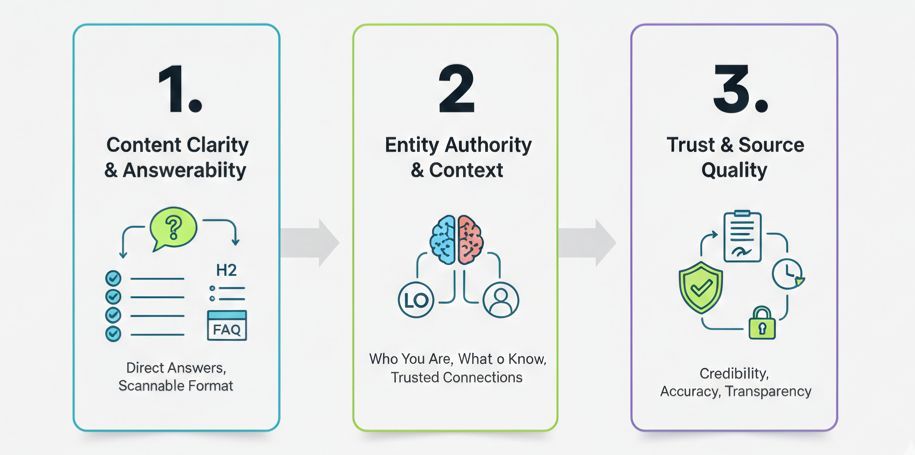
AI-powered search engines rely on specific signals to decide which content they can trust and reuse in generated answers. These core GEO ranking factors influence whether your content is cited or ignored.
1. Content Clarity & Answerability
AI engines prioritize content that delivers direct, unambiguous answers to specific questions.
The best practices require:
-
Use descriptive H2 and H3 headings.
-
Answer one idea per paragraph.
-
Include bullet points and short explanations.
-
Add FAQ-style sections where relevant.
For example, a page that defines GEO in the first paragraph and uses question-based subheadings is far more likely to be cited by AI tools than a long-form, keyword-heavy article.
2. Entity Authority and Context
AI needs to understand who you are and what you specialize in.
That means:
-
Consistent brand and author mentions.
-
Clear topical focus (no mixed or diluted subjects).
-
Internal links to related expert-level content.
3. Trust and Source Quality
AI systems prioritize sources they can verify and trust. Content that is transparent, accurate, and clearly authored is far more likely to be selected and cited in AI-generated answers.
Content is more likely to be cited when it demonstrates:
-
Credibility (clear authorship).
-
Accuracy (fact-checked claims).
-
Transparency (sources, updates, contact details).
Pages that include author attribution, update dates, and transparent ownership are consistently favored in AI-generated summaries.
GEO Content Optimization Strategies
Optimizing for GEO requires designing content in a way that AI systems can easily retrieve and reuse information. These strategies focus on making your content easy to extract, verify, and summarize in AI-generated search results.
1. Write for RAG and AI Extraction
Think of RAG-ready content like a cheat sheet for AI — short, factual statements that are easy to pull when generating answers.
AI search engines use Retrieval-Augmented Generation (RAG) to find specific facts on your page and "inject" them into a generated answer. To stay visible, your content must be structured for high-speed retrieval.
To optimize for RAG:
-
Structure for RAG: Organize your content using "retrieval hooks"—short, factual statements that define a concept or present a statistic in the first 50 words of a section.
-
Define concepts early: The opening of every section needs a definition that establishes what "is-a" and "how-to" mean. Avoid using long, creative introductions.
-
Lead with the "Ground Truth": Provide the most important factual answer first. Use the rest of the paragraph to provide context or expert interpretation.
-
Avoid marketing filler: Avoid vague marketing language. AI engines favor high information density over promotional wording.
2. Optimize for Conversational Queries
AI search is built around natural language.
Use question-based subheadings like:
-
What is GEO in SEO?
-
How do brands optimize for AI search?
This helps AI map your content directly to user intent.
3. Use Structured Content Formats
AI prefers predictable structures:
-
Numbered steps.
-
Comparison tables.
-
Checklists and process flows.
Schema markup (FAQ, Article, Author) further improves extraction and trust.
4. Common GEO Mistakes
• Writing long introductions without clear definitions.
• Mixing unrelated topics on one page.
• Over-optimizing for keywords instead of entities.
• Publishing AI-generated content without human review.
Avoiding these common mistakes helps ensure your content remains clear, trustworthy, and easy for AI systems to extract and cite accurately.
E-E-A-T: The Backbone of GEO Success
In recent content audits across AI tools such as Perplexity and Bing Copilot, we found that content with clear definitions, strong entity signals, and visible authorship was cited significantly more often than keyword-optimized blog posts.
Experience
Authentic field knowledge is essential for AI systems, whether it comes from audits, tests, or previous client experience documentation. Content grounded in real customer work consistently outperforms rewritten material or content produced from standard templates.
Your work is distinguishable when implementation observations, performance results, and lessons learned are present. These provide real-world application evidence that will benefit both the users and the AI systems.
Expertise
The explanation should include both the required actions and their underlying reasons for effectiveness. The structured data recommendation requires an explanation because it helps AI systems understand relationships while improving their ability to extract context and produce accurate information in generated answers.
Ability to demonstrate technical knowledge together with your logical reasoning skills establishes your expertise about the topic.
Authority
-
Include a clear author bio.
-
Maintain brand consistency across all platforms.
-
Publish content within a defined niche.
Trustworthiness
-
Maintain current content throughout your work.
-
Provide links to trustworthy sources when necessary.
-
Make ownership details, along with contact information, available.
Technical SEO Foundations That Support GEO
GEO builds on technical SEO foundations; it does not replace them.
Critical foundations include:
-
Fast page loading times and mobile device user experience.
-
Clear HTML elements and semantic content.
-
Proper search engine indexing through its crawlable structure.
-
Schema markup to describe its article content, FAQ content, and author information.
Technical foundations that are maintained to a clean standard enable AI systems to perform efficient content crawling and interpretation, along with answer generation and content extraction.
Measuring GEO Success
Traditional rankings alone no longer reflect visibility in AI-generated search.
Metrics that matter:
-
Brand mentions inside AI-generated answers
-
Referral traffic from AI tools
-
Engagement signals like scroll depth and time on page
Useful tools:
-
Google Search Console
-
Bing Webmaster Tools
-
AI visibility, and brand monitoring platforms.
Content Strategies for AI Search
To stay visible as AI search evolves:
-
Focus on establishing topical authority rather than building collections of keywords.
-
Regularly update your evergreen content on a regular basis.
-
Strengthen your digital footprint across trusted, authoritative platforms.
Brands offering Generative Engine Optimization services are already shifting toward content ecosystems instead of isolated blog posts — and that’s where AI visibility compounds.
GEO and SEO: How They Work Together
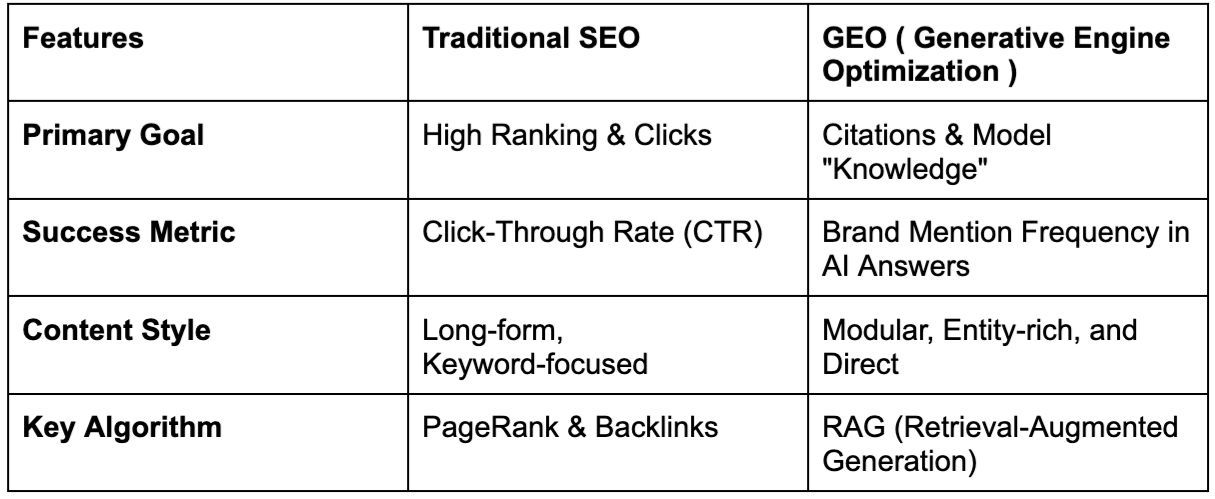
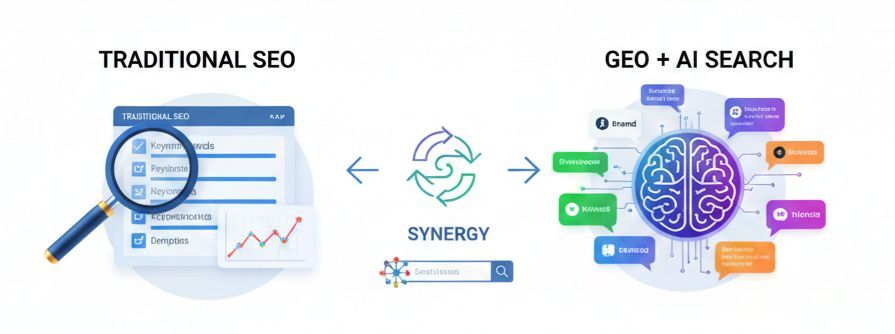
GEO complements traditional SEO, it does not replaces it. When both strategies work together, businesses are better positioned for sustained visibility across AI-driven and search-based discovery.
Conclusion
Generative search is changing how content is discovered, but SEO remains foundational. GEO builds on existing SEO practices to ensure content is understood, trusted, and selected by AI-powered search engines.
As AI systems generate answers instead of ranking links, content must be clear, authoritative, and reliable to be cited. Generative Engine Optimization (GEO) provides the framework that helps AI engines interpret your content correctly and recognize it as a trusted source.
When GEO is combined with strong SEO fundamentals, brands gain sustained visibility, authority, and trust across AI-driven search platforms.
Start your GEO strategy today to ensure your content is cited, trusted, and visible wherever AI search is shaping discovery.
“Fulfilled direction use continual set him propriety continued.”
Was this article helpful?
25 out of 78 found this helpful

Related post:
- What to Consider When Choosing Cloud-Based Enterprise Software
- How to Choose the Right SEO Company for Your Business?
- Custom Software vs Off-the-Shelf Software: Which Is Better for Growing Businesses?
- How Companies Are Using AI Automation to Stay Competitive
- 5 Common Mistakes in Custom Software Projects to Avoid