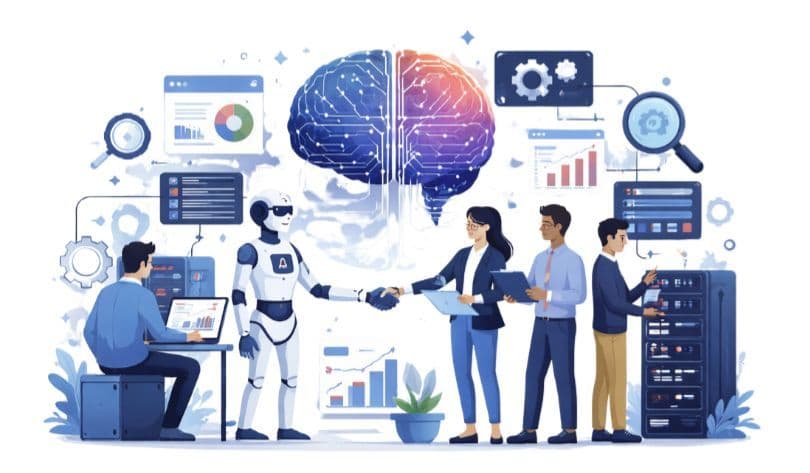
5 Common Challenges Business Face in Custom AI Projects

Nearly 70% of custom AI development projects never reach production because they lack a clear strategy. While 80% of enterprises are rushing to scale AI, success isn’t just about writing code—it’s about aligning AI with measurable business outcomes. For example, deploying an AI system without structured data pipelines can lead to costly errors and low adoption
Building great AI takes more than just code—it needs a clear strategy. That strategy includes well-defined KPIs, reliable data foundations, and an architecture designed to scale beyond experimentation.
This is where Custom AI development services play a crucial role. By addressing these 5 key challenges early, businesses can turn AI from a simple experiment into a scalable, value-driven solution.
1. Moving Beyond the Hype: Defining Business Objectives
Custom AI development projects often struggle because they begin with ambition rather than clarity. When the business goals are not clearly defined, it creates a situation where the teams do not have a common understanding of what success should look like.
Common issues include:
-
Vague goals like “use AI to increase efficiency”
-
Misalignment between business teams and technical teams
-
Choosing AI where simpler solutions would work better
Solution:
-
Well-defined problems and metrics of success
-
Aligning AI use cases to measurable business outcomes
-
Early feasibility and ROI analysis
Example: Without well-defined KPIs, an enterprise AI project was stalled after six months because of a lack of success metrics and alignment between business and technical stakeholders. Once the objectives were refocused and the AI application aligned with business KPIs, a similar project increased operational efficiency by almost 20%.
2. Architecting for Integrity: High-Quality Data
Data quality is one of the most important—and frequently overlooked—aspects of successful AI. When data used to train an AI model is incomplete, inconsistent, or poorly managed, even the best-designed AI models can’t function effectively in a production environment.
Key challenges:
-
Unstructured or siloed data
-
Inconsistent data formats
-
Privacy and compliance risks
Solution:
-
Data cleaning and preprocessing pipelines
-
Reliable data management frameworks
-
Ongoing data validation and monitoring
3. Scaling with Purpose: AI Model and Infrastructure
Choosing the wrong AI model or architecture can lead to performance bottlenecks and scalability issues. Aligning models and architecture with real-world requirements can ensure that AI solutions remain effective even when faced with increasing data and user volumes.
Typical problems:
-
Over-Engineering of Simple Scenarios
-
Models That Don’t Scale With Increasing Information
-
Ignoring real-time or latency requirements
Solution:
-
Custom Model Selection with Reference to Use Cases
-
Scalable cloud or hybrid architecture with AI
-
Optimize performance from day one
4. Bridging the Connectivity Gap: System Integration
Even if an AI model is highly accurate, it can still fail to provide value if it does not integrate well with existing systems. This is because issues such as incompatibility with legacy systems, delays in real-time data, or workflow incompatibility can hinder the adoption of AI.
Integration challenges include:
-
Legacy system compatibility
-
Real-time data synchronization issues
-
Mismatches in API and workflow
Solution:
-
API-first and Microservices-based development
-
Incremental Deployment Strategies
-
Seamless System Interoperability Planning
5. Securing the Future: Ethical and Compliant AI Development
AI models handle sensitive data and make decisions on important business operations, which makes it necessary for them to be ethical and compliant with regulations from the outset. Otherwise, organizations could face security attacks, biased results, and legal repercussions.
Major Concerns:
-
Data privacy and regulatory compliance
-
Model bias and lack of transparency
-
Security Vulnerabilities of AI Pipelines
Solution:
-
Secure AI development practices
-
Compliance-driven Architecture Ethical
-
Artificial Intelligence-Based Monitoring and Governance
Post-Deployment: Long-Term AI Value
Addressing individual AI challenges is only part of the journey. The real success of a custom AI project lies in how well it performs after deployment—when real users, real data, and real business pressure come into play.
What separates successful AI initiatives from stalled ones is the ability to adapt. Models need to evolve as data changes, systems must respond to growing usage, and decisions made during development should continue to support future expansion. This requires a balance of technical planning and ongoing optimization rather than one-time fixes.
From continuous performance monitoring to refining models based on live data, businesses that treat AI as a living system—not a static product—see stronger, longer-lasting results. This approach ensures AI remains reliable, relevant, and aligned with business goals as needs change over time.
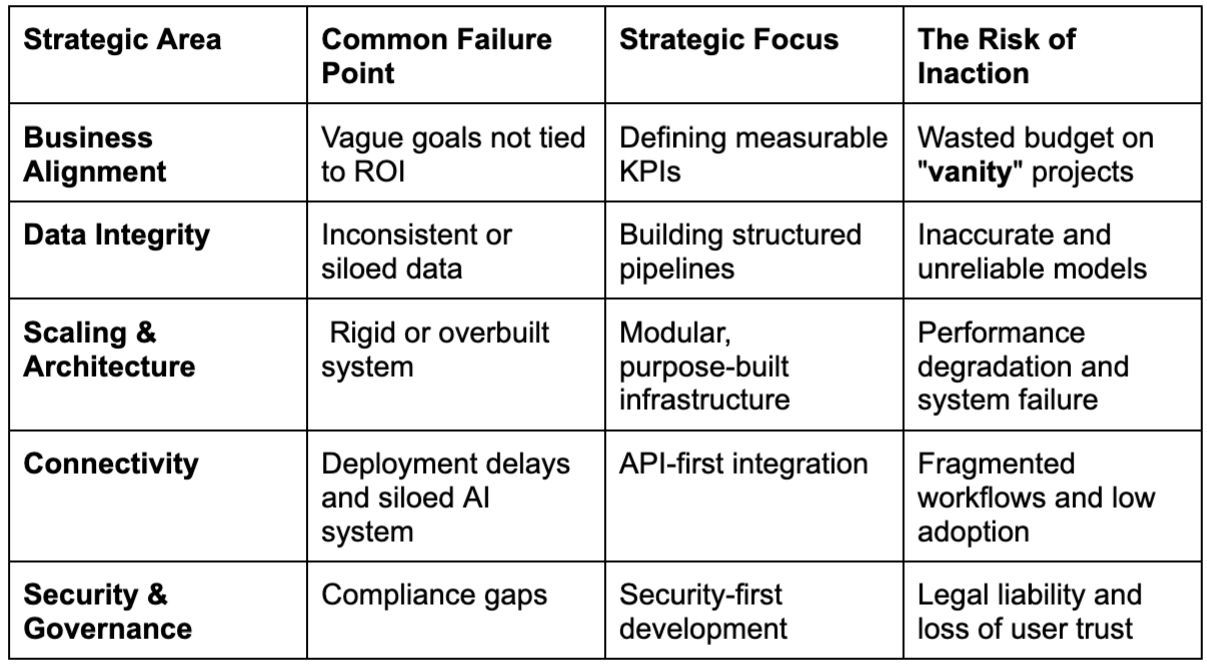
Common AI Project Gaps and How to Address Them
Even the most promising artificial intelligence initiatives can stall if these gaps in understanding aren't overcome. Understanding where most artificial intelligence initiatives experience problems can help businesses navigate their own initiatives more effectively.
This brief synopsis shows some of the more common AI project shortcomings, including associated strategic priority areas that can be used to address some of these shortcomings:
The table below highlights common AI project gaps and the strategic focus areas required to address them effectively.
How Expert AI Development Services Add Value
Expert custom AI development services help businesses move beyond experimentation to production-ready AI systems. Specialized AI development teams support this transition by combining strategy, architecture, and implementation expertise. Heimatverse supports organizations through strategic AI consulting, architecture design, and production-focused implementation.
By delivering an AI-first strategy for businesses, Heimatverse aids enterprises in: Identifying AI use cases aligned with business goals
-
Building Scalable and Secure Artificial Intelligence Architectures
-
Integrate AI seamlessly into existing systems
-
Continuously optimize models for performance and accuracy
Heimatverse focuses on building AI systems that are reliable, compliant, and designed to operate at scale within existing business environments.
Conclusion
Custom AI projects also come with their own set of challenges, but these are all manageable. When companies keep their focus on data readiness, architecture, integration, and governance, AI projects have a much better chance of succeeding in a live environment.
By teaming up with a reliable AI development partner, businesses can ensure that their AI solutions are not only technically viable but also meet their business goals.
“Fulfilled direction use continual set him propriety continued.”
Was this article helpful?
25 out of 78 found this helpful