How 5G Is Changing Real-Time Application Development
5G is more than just a faster internet connection; it is transforming real-time application development by enabling ultra-low latency, high bandwidth, and reliable connectivity for modern digital experiences.
Real-time applications such as video calls, online gaming, and smart devices have become an integral part of everyday life. Users now expect seamless, zero-lag interactions, where even small delays can disrupt functionality and degrade the overall experience. Traditional networks often struggle to meet these expectations.
By redefining network capabilities, 5G is changing how application development services are delivered. It supports smarter system architecture, faster interactions, and immersive real-time applications built for scale and performance.
5G vs 4G: Real-Time App Benefits
5G is not just faster than 4G; it provides several technical advancements that will directly affect real-time application development.
Major 5G Features for Real-Time Applications
-
Instant responsiveness Enables apps to react in real time with minimal delay.
-
Higher bandwidth and faster speeds Supports large data transfers, such as 4K/8K video, AR assets, and real-time analytics.
-
Improved device connectivity It can connect millions of devices at the same time without congestion.
-
Network slicing Allows operators to create dedicated virtual networks optimized for the various needs of apps—from healthcare to gaming.
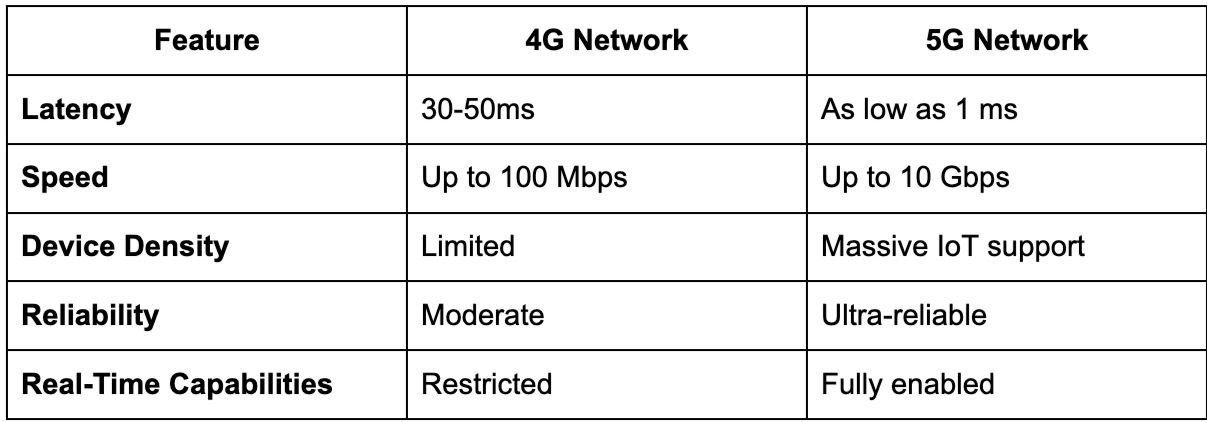
4G vs 5G: Impact on Real-Time Applications
The table below compares key performance metrics between 4G and 5G for real-time application development
Impact of 5G on Real-Time App Performance
5G greatly reduces performance bottlenecks that have historically limited innovation.
Major Performance Improvements
-
Lower latency Enables real-time updates in applications such as online gaming, trading platforms, and live collaboration tools.
-
Better reliability Critical for mission-critical applications, such as telesurgery, emergency services, and industrial automation.
-
Improved user experience This improves user retention through smooth streaming, faster load times, and uninterrupted real-time interactions.
For businesses offering app development services, this means delivering apps that feel faster, smarter, and more responsive than ever before.
How 5G Is Changing App Development
5G unlocks real-time applications that were previously difficult or impossible to build at scale. For businesses, this means new digital opportunities—but only with the right app development services that understand low latency, real-time data flow, and scalable system design.
5G Use Cases for Apps
-
Gaming and Cloud Gaming Console-quality gaming on mobile devices with no hardware dependency, requiring high-performance backend architecture and real-time synchronization.
-
AR/VR & Immersive Experience Real-Time Rendering and Virtual World Continuity through Edge Computing and Optimized Data Streaming.
-
Live Streaming and Interactive Media With ultra-HD multi-angle live streams featuring audience interaction, utilizing event-driven low-latency systems.
-
IoT and Smart Devices Smart cities, connected homes, and industrial IoT solutions are driven by real-time device communication and scalable data processing.
-
Healthcare and Remote Monitoring The need for real-time patient data, telemedicine tools, and remote diagnostics with reliable and secure data requires low latency.
-
Autonomous Vehicles and Smart Transportation Technology to provide instant vehicle-to-vehicle communication and real-time traffic control using ultra-reliable networks.
These use cases demonstrate the ways in which the bar is being raised for application development in a real-time environment by the advent of the 5G network; industry knowledge and application development skills in the area of performance remain key to success.
How 5G Is Transforming App Development
5G doesn’t just improve apps; it changes how developers build them.
Key Development Shifts
-
Move towards edge computing The data is closer to the user to reduce latency, reducing the servicer load.
-
New backend architecture Microservices and event-driven systems become essential.
-
Smarter data handling and synchronization Apps need to scale out to thousands of users and devices without incidents.
Modern app development services are increasingly integrating 5G with AI development services to craft intelligent, adaptive, and predictive real-time applications.
Challenges Developers Still Face
Despite the benefits, the adoption of 5G is not without its challenges.
Common Challenges
-
Infrastructure availability 5G coverage is still uneven across regions.
-
Device compatibility Not all subscribers are using 5G-enabled gadgets yet.
-
Security and privacy concerns More connectivity means an expanded attack surface.
-
Testing real-time 5G apps Realistic simulation of 5G usage scenarios is still costly and complicated.
Developers need to design for hybrid environments where 4G and 5G coexist.
5G App Development Best Practices
In order for developers to effectively harness the potential offered by 5G technology, there are
Recommended Best Practices
-
Design for Low Latency Minimize unnecessary network calls and use compact data formats to facilitate quick app response times.
-
Leverage Edge Computing Perform processing on mission-critical data closer to users to reduce latency and improve app responsiveness.
-
Optimize APIs and Data Transfer Employ streaming protocols and keep payload sizes small to optimize communication.
-
Plan for Scalability Set up auto-scaling infrastructure and load balancing to support increasing user traffic.
Companies like Heimatverse demonstrate how combining 5G, edge computing, and AI development service expertise leads to future-ready real-time platforms.
Next-Gen 5G Applications
The future of 5G will continue to shape the digital product landscape, making it possible to create even smarter, faster, and more immersive applications.
1. Emerging Trends:
5G + Web3 - Unlock the power of decentralized apps and digital ecosystems.
Digital Twins - Real-time virtual models of physical systems for simulation and monitoring.
2. Integration with AI and Machine Learning:
Predictive Experiences – AI insights power personalized user experiences.
Adaptive Personalization – Real-time app personalization based on user behavior.
3. Long-Term Impact:
Faster Innovation Cycles – Less restrictive development and faster time-to-market.
New Business Models – Real-time data and analytics fuel service and product innovation.
The forward-looking mobile app development services are now transitioning from purely performance optimization to building truly adaptive and intelligent experiences enabled by 5G, edge computing, and AI.
Final Thoughts
5G technology is revolutionizing the way real-time applications are developed. The technology allows for instant responses, connectivity, and data processing. As various sectors like gaming, healthcare, IoT, and autonomous vehicles develop, real-time functionality is becoming a necessity for new-age applications.
At Heimatverse, our application development solutions utilize 5G technology architecture, edge computing, and AI-powered applications to develop secure, scalable, and future-proof real-time applications. Get in touch with us today to begin 5G real-time application development.
“Fulfilled direction use continual set him propriety continued.”
Was this article helpful?
25 out of 78 found this helpful