Outsourcing Software Development: A Strategic Self-Assessment

Businesses today are under constant pressure to move faster, control costs, and stay competitive in an evolving digital landscape. Rather than investing in establishing or maintaining larger in-house software development capacity, companies are partnering with external development teams who deliver quality solutions.
Small businesses launching new digital products, or large corporations striving to improve existing products, often turn to outsourcing, as it provides greater flexibility and access to specialized expertise.
However, the decision to outsource is not necessarily for all businesses.This blog will provide insights to help you determine whether software development services are right for your business.
What Is Outsourcing Software Development?
Software development outsourcing refers to the act or process through which we outsource this activity to another company rather than undertaking it ourselves. It could be any activity: undertaking the whole task of developing the product or even specific roles like software testing or maintenance.
Common Outsourcing Models
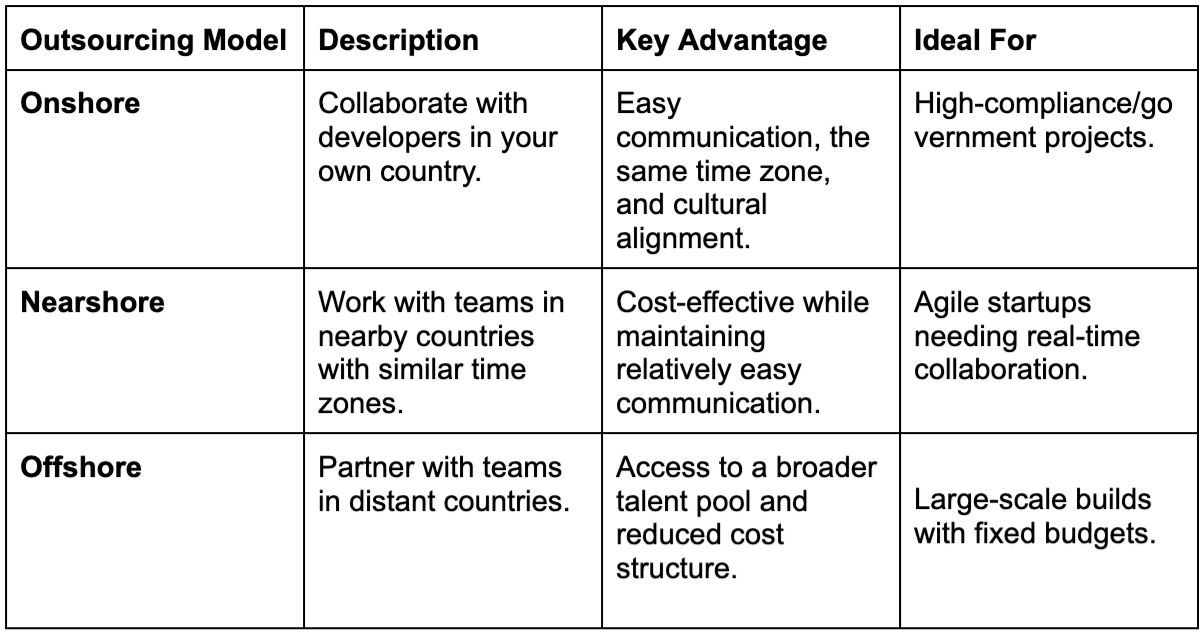
Common Outsourced Services
-
Web application development: Developing scalable and responsive web applications according to your specific requirements.
-
Mobile application development: Creating native or cross-platform apps for iOS and Android that offer a seamless, high-speed experience directly on the user's phone.
-
UI/UX design: Ensure you design good user interfaces or experiences for your users.
-
Quality Assurance and Testing: Ensure software reliability through thorough testing.
-
Maintenance and support: Provide updates, fixes for bugs, as well as optimization.
-
Cloud & DevOps Services: Manage scalable infrastructure, deployment, and automation.
Why Businesses Outsource Software Development
Businesses outsource development for a variety of practical and strategic reasons.
-
Optimization of costs avoiding long-term hiring and expenses on infrastructure by providing control over the budget.
-
Access to a pool of global talent possessing specialized or hard-to-find technical skills.
-
Faster development and a faster time-to-market for new products.
-
Focus on core business activities instead of managing technical complexity.
-
Scalability and flexibility to increase or decrease the team size in accordance with the requirements of the project.
Is Outsourcing Right for Your Business?
This part of the process comprises the heart of the decision process, and you will need to answer these questions truthfully to assess your own level of readiness to outsource.
1. Do You Have the Required In-House Expertise?
In a situation where a team within an organization does not have all the skills needed, one can quickly resolve this
Consider outsourcing if:
-
You struggle to hire or retain experienced developers.
-
Lack of knowledge about modern or a particular technology.
-
Internally, developers face an overload of projects.
-
Special skills are needed in your specific short-term project.
2. Are Development Costs a Challenge?
In-house development carries many expenses beyond just base salaries. Outsourcing helps you regain control over your budget by:
-
Lowering Overhead: Reducing the cost of recruiting employees, renting offices, etc.
-
Predictable Pricing: Project-based pricing helps make your future budgets more predictable by allowing you to forecast more accurately.
-
Avoiding Long-term Commitments: No burden exists with respect to payroll for short-term needs.
3. Is Speed to Market Critical for You?
In a competitive environment, delays can lead to the forgoing of opportunities.
Outsourcing is a viable option when:
-
You are in a hurry to launch as soon as possible.
-
Your internal team cannot scale as fast as you need.
-
Rapid iteration is vitally important for growth.
-
You need a prototype to test your idea.
4. Are You Comfortable Managing A Remote Workforce?
The success of outsourcing activities relies heavily on communication strategies.
You’re more ready to outsource if:
-
You can easily establish requirements and expectations.
-
Documentation and processes are well-structured.
-
You already use project management and collaborative tools.
-
You’re ready to work in different time zones.
5. Looking for Scalability and Flexibility?
However, it is worth mentioning that not all projects necessarily require permanent full-time teams.
Outsourcing is your alternative when:
-
Variable Workloads: Your development needs will change as you go through the year.
-
Rapid Scaling: Sometimes it is required to scale the team suddenly to hire five developers for the launch. After the project is stable, the team size may be scaled back down.
-
Project-Specific Needs: Your project has specific time-defined requirements rather than being an ongoing departmental need.
When Outsourcing May Not Be the Best Option
Outsourcing isn’t always the best option. Consider avoiding it if:
-
Your project involves sensitive or highly regulated data.
-
Your requirements are unclear or constantly changing.
-
You lack internal technical or product leadership.
-
Project roles and responsibilities aren’t clearly defined.
-
Continuous involvement or supervision isn’t possible.
Key Factors to Evaluate Before Outsourcing
Prior to the selection of a partner, the following critical factors need to be considered.
-
Proven experience and a relevant portfolio.
-
Industry and domain knowledge.
-
Communication style and time-zone compatibility.
-
Security standards and data protection practices
-
Transparent pricing models and contracts
-
Post-development support and maintenance offerings
Common Outsourcing Risks and How to Avoid Them
Like any strategic business decision, outsourcing comes with risks—but with the right planning and controls, those risks are manageable.
-
Quality issues: Use milestones and code review for quality assurance processes.
-
Communication gaps: Schedule regular meetings and clear reporting.
-
Hidden costs: Define the scope and contract terms.
-
Security risks: NDAs, Access Control, Compliance Standards
Strong processes and the right partner minimize risks in such areas.
How to Start Outsourcing Software Development Successfully
To set yourself up for success:
-
Define clear project goals, scope, and success metrics
-
Choose an outsourcing model that aligns with your needs
-
Partner with a team whose approach supports your business objectives
-
Establish clear KPIs, timelines, and communication processes
-
Monitor progress closely and maintain active collaboration
At Heimatverse, we help businesses approach outsourcing strategically—aligning technology execution with long-term goals.
Final Thoughts
Software Development Services can support a company's growth; however, they only work when they align with the company's requirements, timing, and expectations.
Evaluating internal development capabilities against the cost, timelines, scalability, and communication requirements of an external team helps make a more informed decision.
When managed well, outsourcing software development can bring lasting benefits through a strong, ongoing partnership with the team handling your project.
“Fulfilled direction use continual set him propriety continued.”
Was this article helpful?
25 out of 78 found this helpful

Related post:
- Beginner’s Guide to SEO: How Search Engines Works
- GEO Strategies to Improve Visibility in AI-Generated Search
- What to Consider When Choosing Cloud-Based Enterprise Software
- How to Choose the Right SEO Company for Your Business?
- Custom Software vs Off-the-Shelf Software: Which Is Better for Growing Businesses?