Case Study · Influencer Marketing
One platform from
brand deal to creator payout.
Trendifyy runs influencer campaigns where sales, ops and finance all touch every deal. Heimatverse designed and built the platform that connects them: campaigns, creator payouts, invoicing and profit, in one place.
Industry
Influencer marketing
Our role
Product design, full-stack build, access control
Stack
Next.js · PostgreSQL · Drizzle · NextAuth · AWS S3
The Problem
Campaign money was moving faster than the tools tracking it.
Trendifyy runs influencer campaigns where three teams touch every deal. Sales talks to brands, ops manages creators, and finance pays and invoices. Each team worked from its own sheets and chats. We found five problems in our first sessions with the team.
01
Campaign details lived in scattered spreadsheets
Brand, objective, budget and creator list sat in different files. Nobody could open one place and see the real state of a campaign.
02
No clear owner for each campaign
A campaign had a sales contact and an ops person, but that was never recorded in one system. Handoffs got missed, and it wasn't obvious who to ask.
03
Creator payouts were hard to track
Creators are often paid in parts. Without a record of each payment, finance couldn't say what had gone out, what was pending, and what still depended on the brand paying first.
04
Profit was visible only after the fact
What a brand pays against what creators cost is the whole margin. Overruns showed up late, once the money was already committed.
05
Everyone saw too much, or too little
Sales shouldn't see creator rates, and ops shouldn't see brand commercials. Sharing a sheet meant sharing everything, or running separate copies that drifted apart.
The Solution
We built one platform for the whole campaign, from brand deal to creator payout.
Heimatverse designed and built Trendifyy Finance as a single system with a dedicated console for sales, ops and finance. Each team sees what it needs and nothing else.
01 / 06
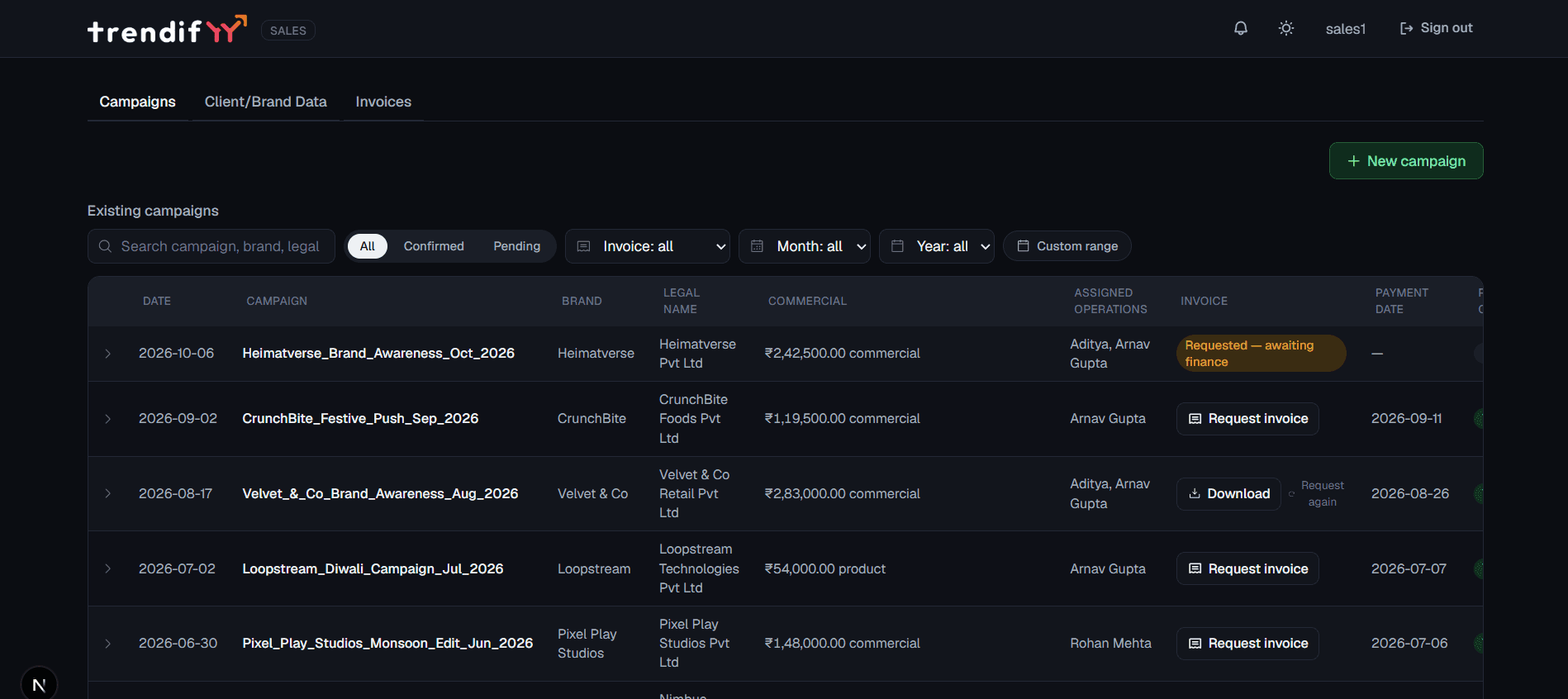
A sales console to launch campaigns
Sales creates a campaign in one form: brand, legal entity, objective, date, commercial terms, number of creators and an ops owner. The campaign name is generated automatically, so naming stays consistent across hundreds of campaigns. Sales can then track payment dates and request invoices without leaving the page.
02 / 06
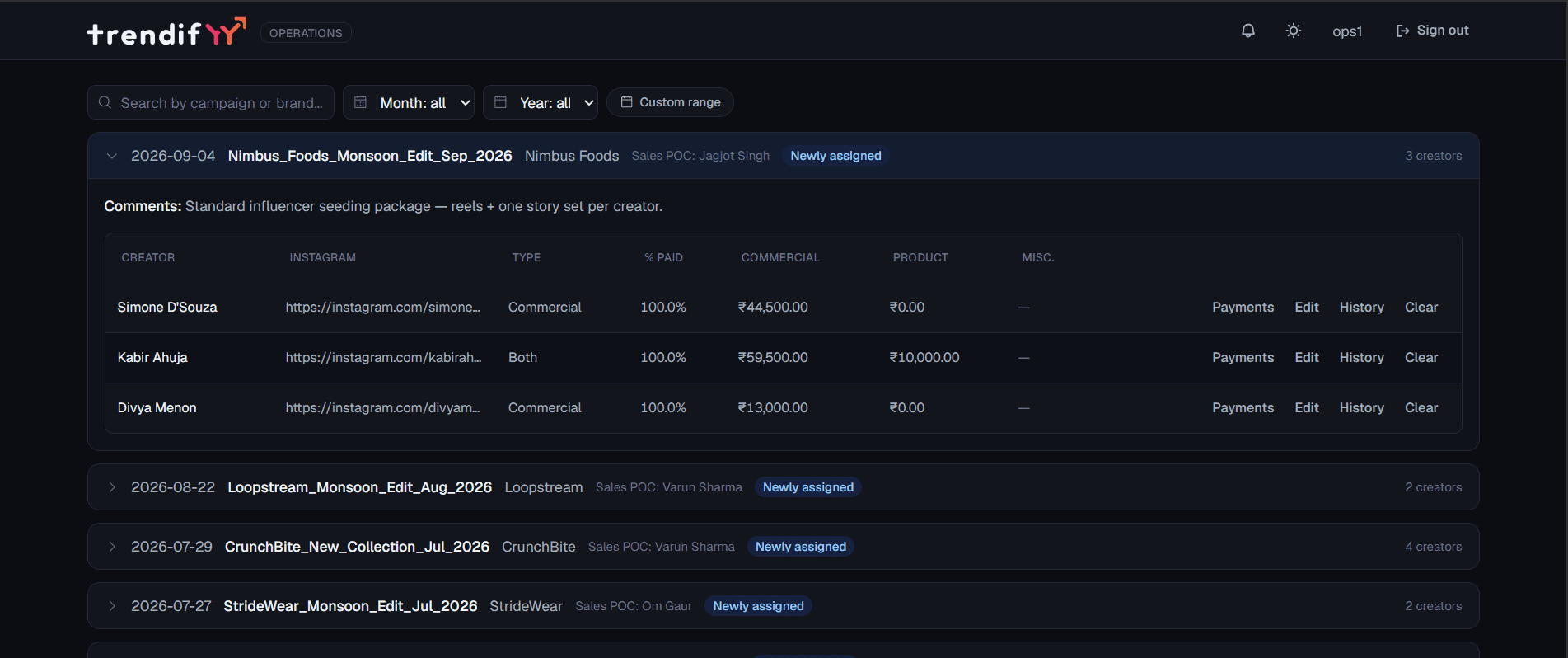
An ops console for creators and payouts
Ops sees only the campaigns assigned to them. They fill in each creator's profile link, commercial terms and amount, and the platform calculates what is owed. Payouts are logged in tranches, so part-payments are recorded instead of guessed.
03 / 06
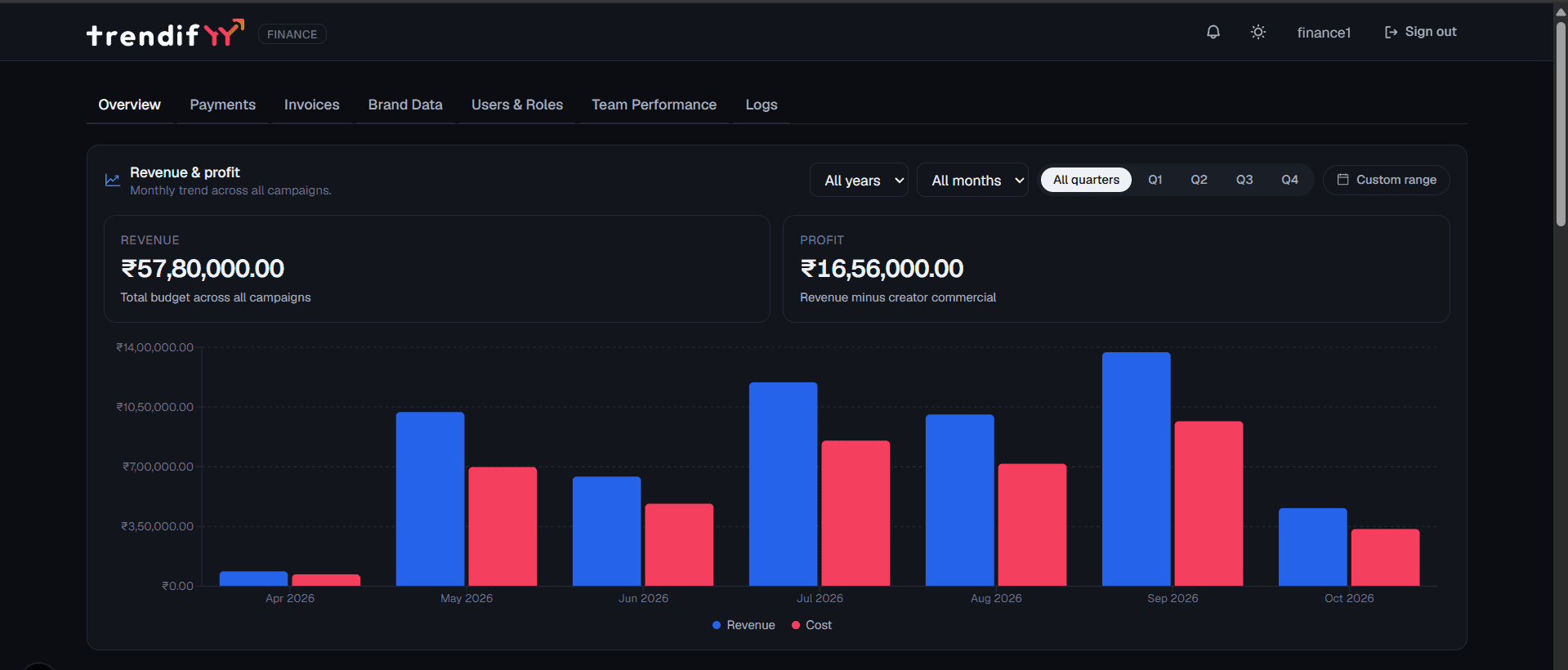
A finance dashboard with live profit
Finance gets one view of revenue, creator cost, profit and profit margin, with a monthly revenue and profit chart you can filter by year or quarter. A budget alert panel flags any campaign where creator cost has passed the brand's budget, worst first.
04 / 06
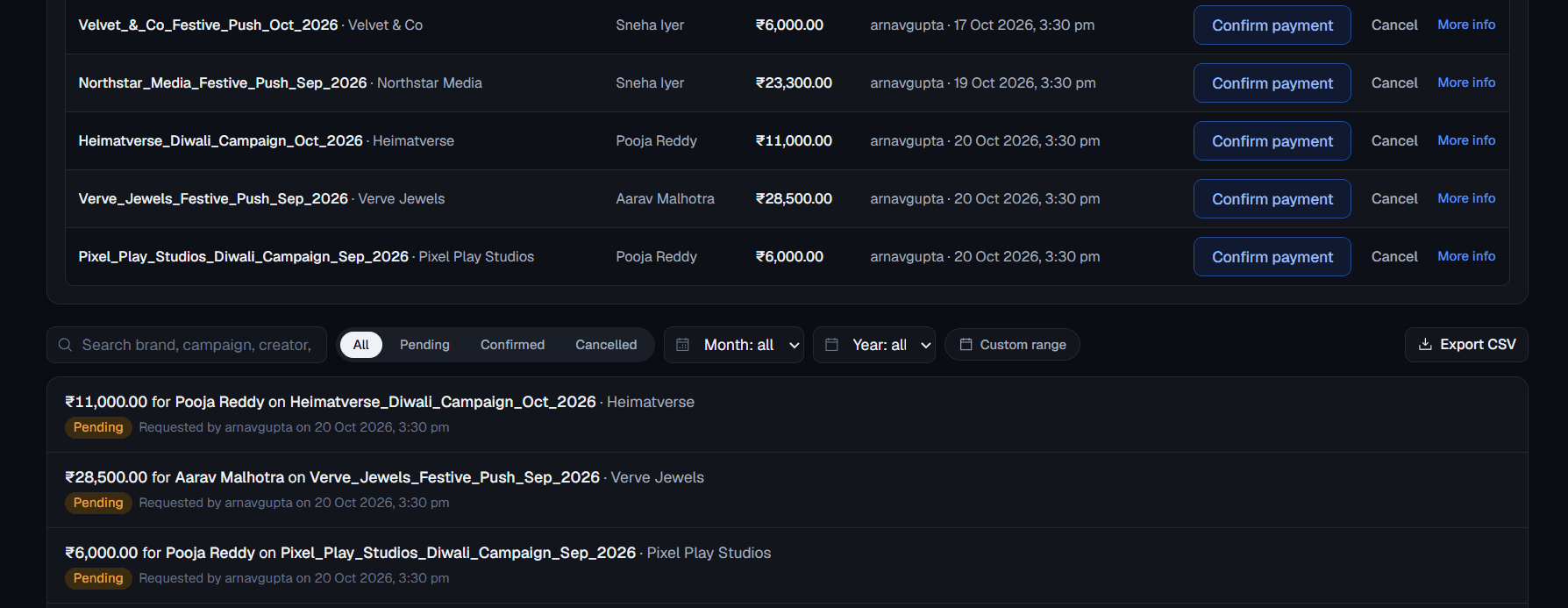
Payment confirmation and an invoice workflow
Ops requests a creator payment, and finance confirms it. Sales requests an invoice, finance uploads the real PDF, and sales downloads it. A payments log keeps every disbursement on record, and finance can filter and export it to CSV.
05 / 06
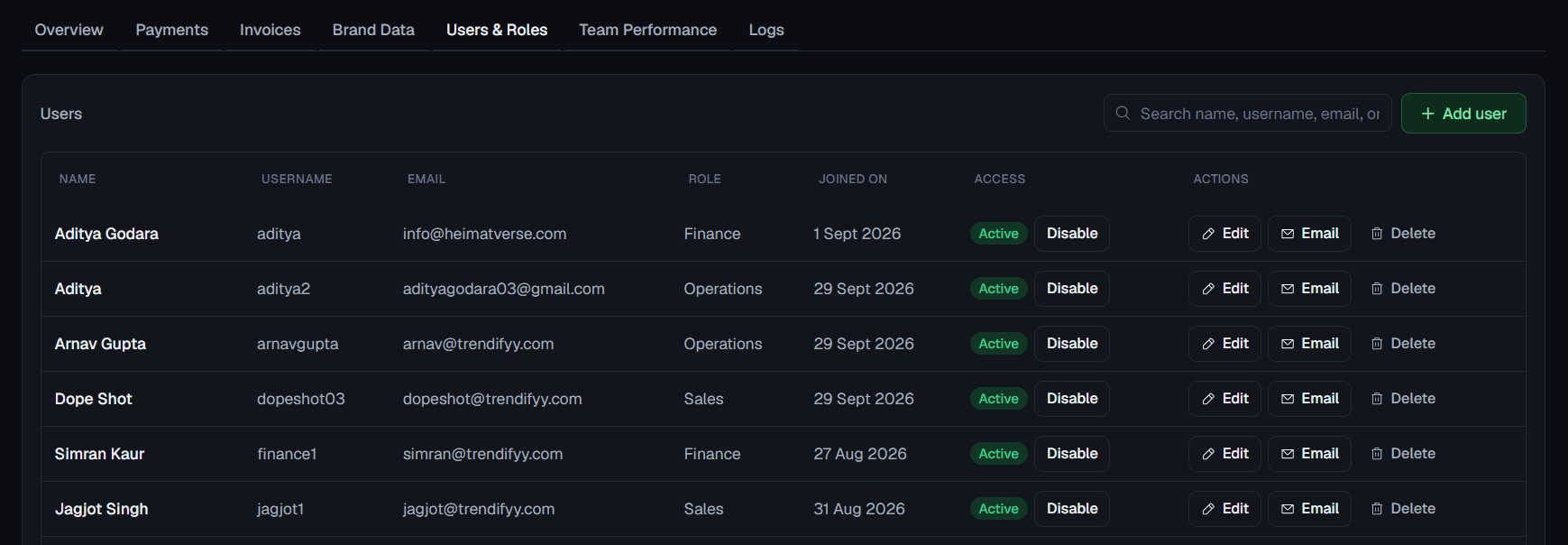
Role-based access, enforced on the server
Sales and ops are deliberately blind to each other's fields. Finance sees everything but can only change what it should. Every rule is checked on the server, not just hidden in the interface, so access doesn't depend on someone not clicking the wrong button.
06 / 06
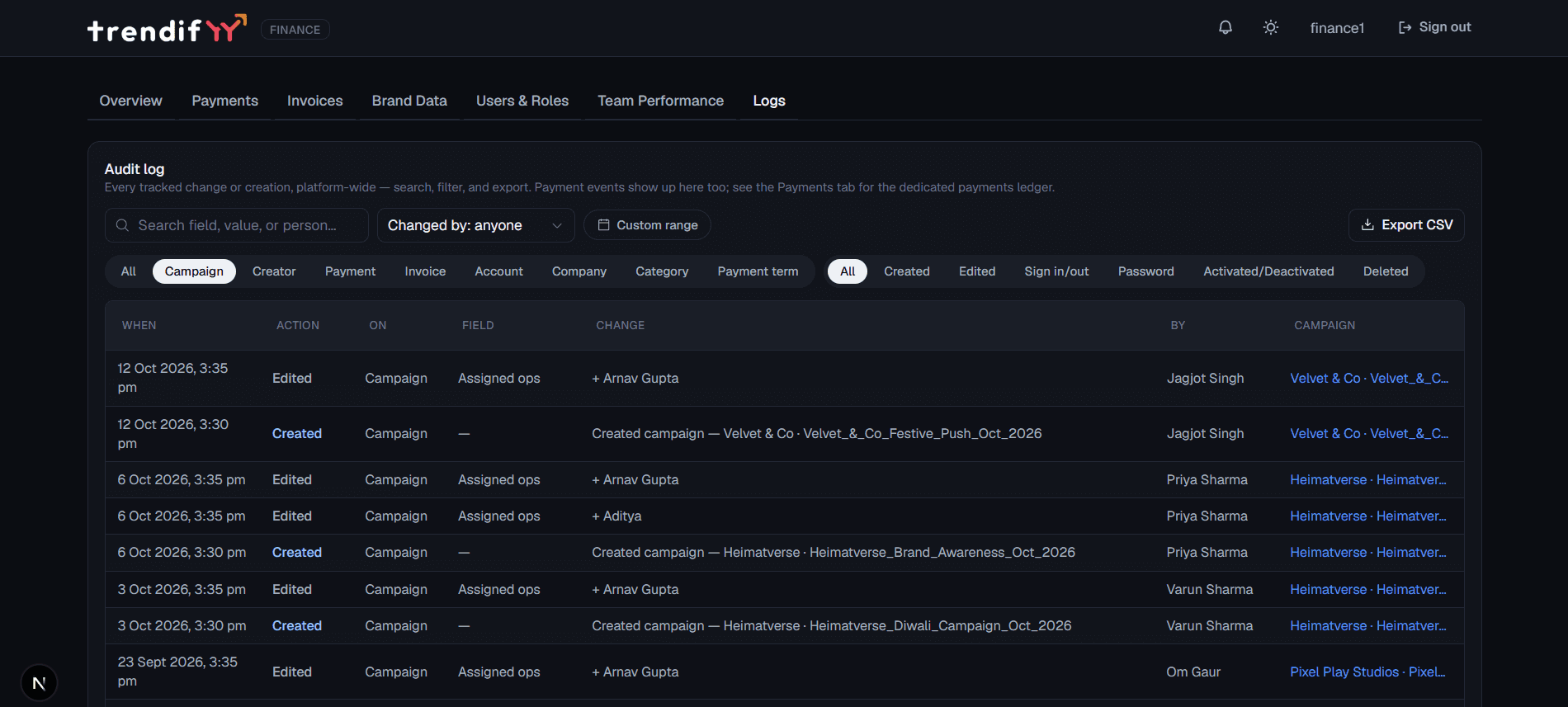
Notifications, history and an audit trail
Teams get notified when something needs their action. Every change to a campaign or creator is recorded with who made it and when, so questions about a number can be answered from the system itself. Finance can also reassign a campaign's sales or ops owner when someone leaves.
How We Worked
Money rules first, screens second.
01
We mapped how a campaign makes and spends money
Before designing anything, we sat with the Trendifyy team and traced a campaign from the brand deal to the final creator payment. We wrote down which team owns each step and which numbers each team should be allowed to see.
02
We built access and data rules before the interface
We defined roles, the data model and the permission checks first, then built the three consoles on top. The platform fit how the team already split its work, so there was little to retrain.
03
We shipped console by console and tested each one
Sales, ops and finance were released in turn, each reviewed with the team before the next began. Every console has automated tests, including tests against a real database. Later additions like payment tranches, invoice requests and budget alerts came from watching the team use the earlier versions.
The Outcome
Every campaign, every creator, every rupee in one place.
Trendifyy now runs its campaigns, creator payouts and invoicing on one platform built by Heimatverse. Every campaign has an owner on the sales side and the ops side. Every creator payment is recorded, confirmed and logged. Finance can see revenue, cost and profit as they change, and gets a warning when a campaign overspends.
Sales and ops keep to their own side of the data, and the audit trail shows who changed what. The team spends less time chasing numbers across sheets and more time on brand and creator relationships.
“When three teams touch the same money, the real product is the rules: who sees what, who can change what, and who signed it off. Get those right first and the interface is the easy part.”
Tags
Money moving through too many sheets?
Heimatverse designs and builds custom platforms around how your team really works. Tell us what is slowing you down.
Let's build